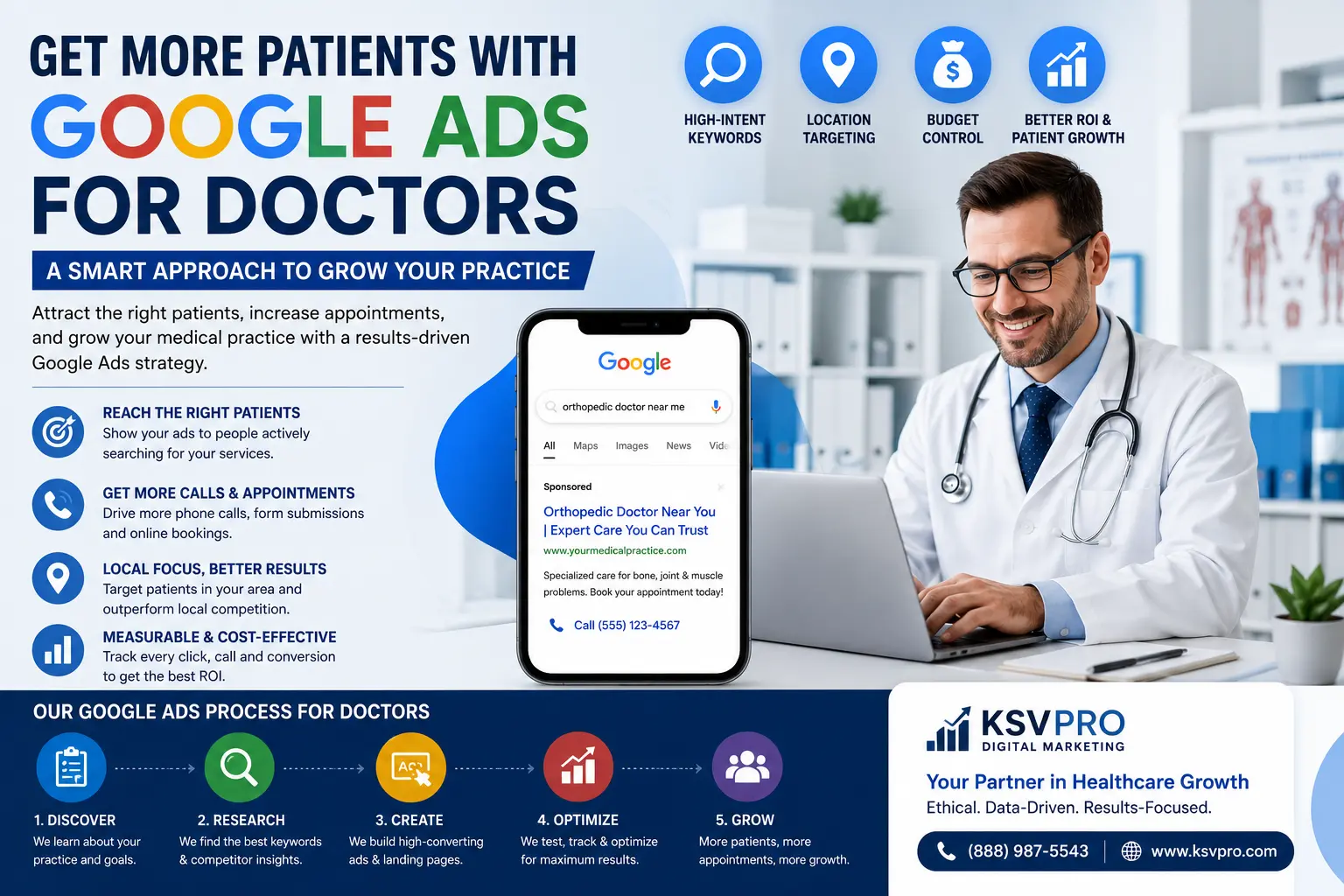
Google Ads for doctors seo outline
Healthcare has become more competitive than ever. Patients no longer rely only on referrals from friends or family members—they turn to Google when searching for doctors, specialists, clinics, and healthcare providers. Whether someone needs a family physician, dermatologist, dentist, orthopedic surgeon, or urgent care clinic, their journey often begins with a search.
Many doctors invest thousands of dollars in advertising but struggle to generate consistent appointments. One common reason is that their campaigns lack a structured strategy. Running ads without clear objectives, keyword research, proper targeting, and conversion tracking often leads to wasted advertising spend and low-quality leads.
A well-planned Google Ads for doctors seo outline provides the framework needed to reach the right patients at the right time. Instead of relying on guesswork, medical practices can build campaigns that align with patient intent, local demand, and measurable business goals.
At KSVPro Digital Marketing, our approach focuses on ethical, data-driven marketing strategies that help healthcare providers improve visibility, attract qualified patients, and continuously optimize campaign performance. Based on industry best practices, successful medical advertising combines smart campaign planning, relevant landing pages, accurate tracking, and ongoing optimization.
This guide explains every major component of a successful Google Ads for doctors seo outline, helping physicians, private practices, specialists, hospitals, and healthcare providers understand how to build campaigns that support sustainable patient acquisition.
Why Doctors Need Google Ads in 2026
Digital healthcare marketing continues to evolve as patient expectations change. Most prospective patients expect immediate answers, online appointment scheduling, mobile-friendly websites, and trusted healthcare information before choosing a provider.
Google Ads allows medical practices to appear at the top of search results precisely when patients are actively looking for care. Unlike traditional advertising, paid search targets users with high purchase intent, making it one of the most effective channels for doctor lead generation.
Some of the key benefits include:
- Immediate visibility in Google Search
- Reach patients actively seeking medical services
- Geographic targeting for local practices
- Budget flexibility for practices of all sizes
- Measurable return on investment
- Detailed performance reporting
- Faster patient acquisition compared to many traditional marketing channels
Patients Search Before They Choose
Today’s patients often research:
- Symptoms
- Nearby clinics
- Insurance acceptance
- Doctor reviews
- Appointment availability
- Treatment options
- Office hours
Appearing during these searches can significantly increase opportunities to attract qualified patients.
Local Search Has Become Essential
Most medical practices serve patients within a defined geographic area. Google Ads enables healthcare providers to display advertisements only within selected cities, ZIP codes, or driving distances, reducing wasted advertising spend.
For example, a cardiology clinic in Dallas can limit ads to nearby communities rather than paying for clicks from users located hundreds of miles away.
Faster Results Than Organic SEO Alone
Medical SEO remains an important long-term investment, but it often takes months to build consistent organic rankings. A well-managed Google Ads campaign can begin generating qualified traffic much sooner while SEO efforts continue to grow.
Rather than choosing between paid advertising and SEO, many successful healthcare providers use both together to maximize visibility.
What Makes Google Ads Different for Healthcare?
Healthcare advertising requires a higher level of planning than many other industries. Medical practices must balance effective marketing with patient trust, privacy expectations, and advertising policies.
Unlike retail businesses, healthcare providers often market services involving sensitive health topics. This means campaigns should focus on education, professionalism, and relevance rather than exaggerated claims.
Patients Need Trust Before They Click
Trust influences nearly every healthcare decision.
Landing pages and advertisements should communicate:
- Professional expertise
- Clear service offerings
- Convenient appointment options
- Accurate business information
- Transparent contact details
- Easy navigation
- Mobile-friendly experience
When patients immediately find the information they need, they are more likely to schedule an appointment.
High-Intent Searches Matter Most
Healthcare advertising performs best when targeting users with immediate needs.
Examples include searches such as:
- Family doctor near me
- Pediatric clinic open today
- Sports injury specialist
- Dermatologist accepting new patients
- Physical therapy clinic nearby
These searches often indicate that a patient is actively seeking care rather than casually browsing.
Local Competition Is Strong
In many cities, several providers offer similar services. Effective Google Ads management for doctors requires identifying opportunities to stand out through:
- Relevant ad copy
- Location-specific messaging
- Strong landing pages
- Accurate targeting
- Ongoing campaign optimization
Compliance Is Critical
Medical advertising must remain accurate and professional.
Healthcare marketers should avoid:
- Misleading guarantees
- Unsupported medical claims
- False promises of outcomes
- Sensational language
- Inaccurate treatment information
A trustworthy advertising strategy not only supports compliance but also strengthens patient confidence.
Google Ads for doctors seo outline
A successful Google Ads for doctors seo outline is more than launching advertisements. It is a structured framework that aligns business goals, patient intent, campaign organization, and continuous optimization.
Below is a step-by-step outline that many healthcare providers can use as a foundation for building effective campaigns.
Step 1: Define Campaign Objectives
Every campaign should begin with a clear objective.
Common goals include:
- Increase appointment bookings
- Generate phone calls
- Promote specialty services
- Increase local visibility
- Attract new patients
- Grow private practice revenue
Without measurable objectives, evaluating campaign success becomes difficult.
Step 2: Perform Keyword Research
Keyword research determines when advertisements appear.
Effective keyword selection focuses on high-intent searches instead of broad informational phrases.
Examples include:
- Google Ads for doctors
- Medical Google Ads
- Google Ads for healthcare providers
- PPC for doctors
- Healthcare PPC
- Medical PPC services
- Doctor lead generation
- Medical practice marketing
Long-tail keywords often produce more qualified traffic because they reflect specific patient needs.
Step 3: Understand Your Audience
Different healthcare specialties attract different patient groups.
Consider:
- Age
- Gender
- Location
- Family status
- Insurance preferences
- Medical concerns
- Search behavior
Understanding these characteristics improves ad relevance and campaign performance.
Step 4: Location Targeting
Most patients prefer nearby healthcare providers.
Google Ads allows practices to target:
- Cities
- ZIP codes
- Counties
- Radius targeting
- Service areas
Location targeting helps reduce wasted clicks while improving lead quality.
Step 5: Budget Planning
Advertising budgets should align with practice goals rather than arbitrary spending limits.
Factors influencing budget include:
- Local competition
- Cost per click
- Specialty demand
- Geographic area
- Patient lifetime value
- Available appointment capacity
A realistic budget supports consistent optimization over time instead of short-term experimentation.
Step 6: Select the Right Bidding Strategy
Different campaign objectives require different bidding approaches.
Common options include:
- Maximize Conversions
- Maximize Clicks
- Target CPA
- Target ROAS (when appropriate)
- Manual CPC for greater control
The ideal strategy depends on available conversion data and business goals.
Step 7: Build Dedicated Landing Pages
Sending visitors to a generic homepage often reduces conversion rates.
Each advertisement should direct patients to a page focused on a specific service, such as:
- Family medicine
- Orthopedics
- Pediatrics
- Cardiology
- Dermatology
- Physical therapy
Relevant landing pages improve user experience and Quality Score.
Step 8: Implement Call Tracking
Many medical appointments begin with a phone call.
Tracking phone inquiries helps practices understand:
- Which campaigns generate calls
- Call duration
- Peak inquiry times
- Advertising ROI
Without call tracking, valuable conversion data may be lost.
Step 9: Configure Conversion Tracking
Successful campaign management depends on accurate measurement.
Important conversions include:
- Appointment requests
- Contact forms
- Phone calls
- Online scheduling
- Live chat interactions
Reliable conversion tracking enables continuous improvement.
Step 10: Use Remarketing Strategically
Not every visitor books an appointment immediately.
Remarketing allows practices to reconnect with previous website visitors using relevant messaging.
This can improve brand recognition and encourage prospective patients to return when they are ready to schedule care.
Step 11: Optimize Campaign Performance
Continuous optimization is essential.
Regular reviews should examine:
- Click-through rate (CTR)
- Conversion rate
- Cost per conversion
- Search terms
- Negative keywords
- Device performance
- Geographic performance
- Ad copy effectiveness
Small improvements made consistently often produce significant long-term gains.
Step 12: Maintain Compliance
Healthcare advertising should prioritize accuracy, transparency, and professionalism.
Before launching campaigns, practices should review:
- Ad copy
- Landing page content
- Privacy considerations
- Contact information
- Service descriptions
- Medical claims
Maintaining high standards supports patient trust while reducing compliance risks.
By following this Google Ads for doctors seo outline, healthcare providers can create campaigns that are better organized, easier to measure, and more likely to attract qualified patients. While every medical practice has unique goals and competitive conditions, building a strong foundation with clear objectives, targeted keywords, optimized landing pages, accurate tracking, and ongoing refinement creates a scalable strategy for long-term growth.
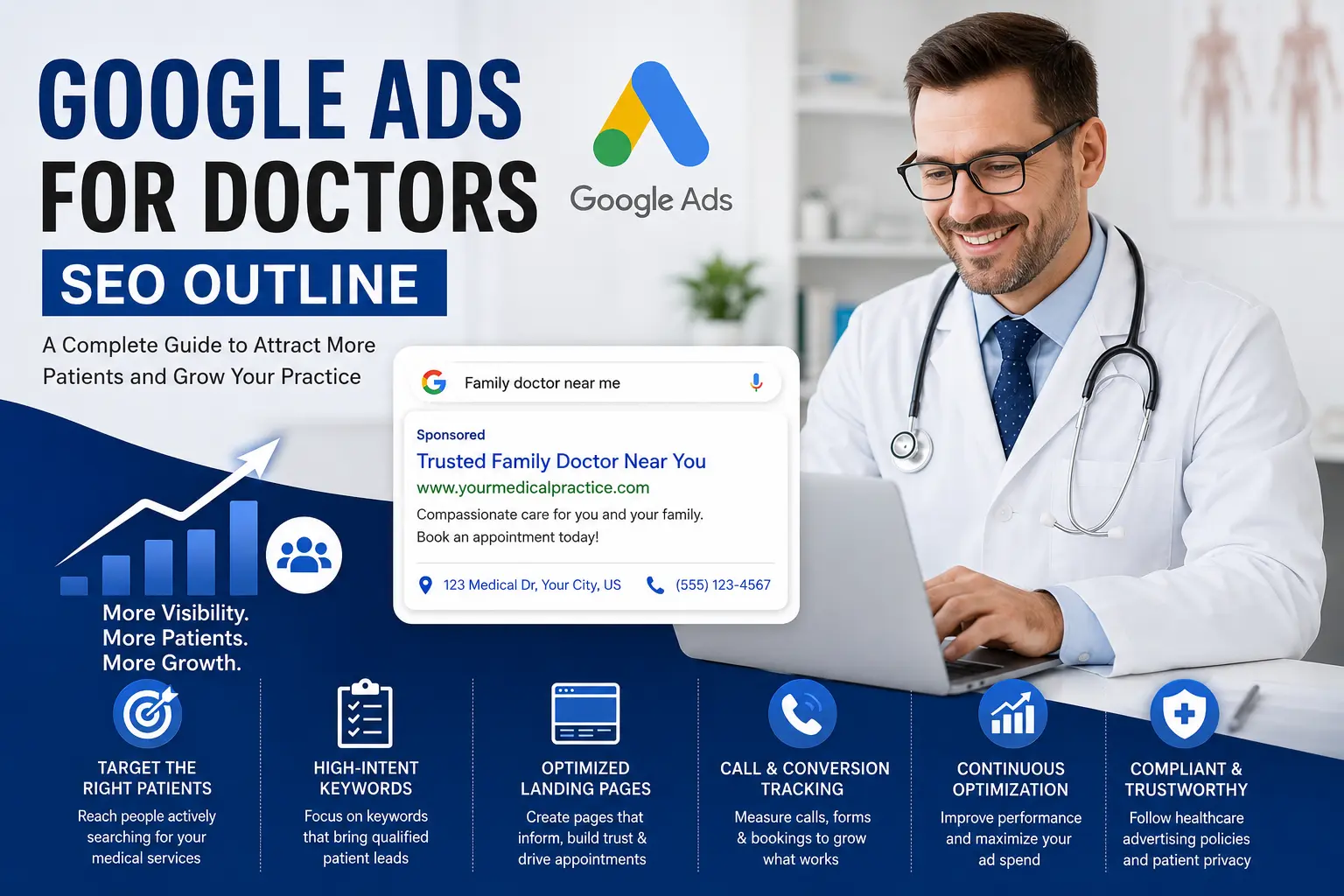
Choosing High-Intent Keywords
Keyword selection is one of the most important factors in any successful Google Ads campaign. Even the best-written advertisements cannot generate consistent results if they appear for the wrong searches. The goal is not simply to drive traffic—it is to attract potential patients who are actively looking for medical services and are ready to take action.
For healthcare providers, focusing on search intent is far more valuable than targeting high-volume keywords alone. A person searching for general health information is at a different stage of the decision-making process than someone searching for a doctor in their local area.
Understand Search Intent
Search intent generally falls into four categories:
Informational Searches
These users are looking for answers or educational content.
Examples include:
- What causes knee pain?
- Symptoms of seasonal allergies
- How to treat migraines
These searches are valuable for content marketing and Medical SEO, but they may not generate immediate appointments through paid advertising.
Navigational Searches
Users already know which provider or clinic they want to visit.
Examples include:
- Smith Family Medical Center
- Downtown Pediatrics phone number
While these keywords may have lower competition, they are typically not the primary focus for patient acquisition campaigns.
Commercial Investigation
Potential patients are comparing providers before making a decision.
Examples include:
- Best dermatologist in Houston
- Orthopedic surgeon reviews
- Pediatric clinic near me
These searches indicate a higher level of interest and often lead to future appointments.
Transactional Searches
These are the highest-value searches for Google Ads for doctors because users are ready to schedule care.
Examples include:
- Urgent care open now
- Dentist accepting new patients
- Cardiologist near me
- Same-day clinic appointment
These keywords often produce the strongest return on advertising investment.
Focus on Service-Specific Keywords
Instead of using broad medical terms, build campaigns around the services your practice offers.
Examples include:
- Family medicine
- Internal medicine
- Dermatology
- Orthopedics
- Cardiology
- Physical therapy
- Women’s health
- Pediatric care
Each service should ideally have its own ad group with highly relevant advertisements and dedicated landing pages.
Combine Services with Location
Local intent is essential in healthcare advertising.
Examples include:
- Pediatrician in Phoenix
- Dermatologist in Miami
- Family doctor near Austin
- Orthopedic clinic in Denver
Location-based keywords help connect your practice with patients searching within your service area.
Use Long-Tail Keywords
Long-tail keywords typically have lower competition and attract users with clearer intent.
Examples include:
- Google Ads for doctors seo outline in US
- Google Ads for doctors seo outline for medical clinics
- Google Ads for doctors seo outline for physicians
- Google Ads for doctors seo outline campaign strategy
- Google Ads for doctors seo outline checklist
Long-tail searches often lead to better engagement because they closely match what users are looking for.
Build a Strong Negative Keyword List
Negative keywords prevent ads from appearing for irrelevant searches, helping reduce wasted spend.
Examples include:
- Free
- Jobs
- Salary
- Training
- School
- Course
- Certification
- Template
- Internship
Reviewing search term reports regularly allows advertisers to discover additional negative keywords and improve campaign efficiency.
Organize Campaigns by Medical Service
A common mistake is placing every keyword into one campaign. A better approach is to organize campaigns by specialty or service line.
For example:
Campaign: Family Medicine
- Annual physical exam
- Family physician
- Preventive care
- Primary care doctor
Campaign: Dermatology
- Acne treatment
- Skin cancer screening
- Mole removal
- Eczema specialist
This structure improves ad relevance, Quality Score, and overall performance.
Building High-Converting Landing Pages
Generating clicks is only the beginning. Once a prospective patient visits your website, the landing page must provide the information needed to build confidence and encourage action.
Many healthcare providers lose potential patients because their landing pages are slow, confusing, or lack clear calls to action. A well-designed landing page supports both Google Ads optimization and overall patient acquisition efforts.
Match the Landing Page to the Advertisement
Every advertisement should lead to a page that directly matches the user’s search.
For example:
- An ad promoting knee pain treatment should direct users to a knee pain treatment page.
- An ad for pediatric services should lead to a pediatric landing page.
- An ad for urgent care should display urgent care information immediately.
Consistency between ads and landing pages improves user experience and Quality Score.
Build Trust Immediately
Healthcare decisions involve trust. Patients want reassurance that they are choosing a qualified provider.
Include trust signals such as:
- Provider credentials
- Years of experience
- Medical specialties
- Professional affiliations
- Office photos
- Patient-focused content
- Insurance information (when applicable)
- Accurate business contact details
Rather than making exaggerated claims, present factual information that helps patients make informed decisions.
Make Appointment Booking Easy
A landing page should guide visitors toward one clear action.
Include:
- Online appointment scheduling
- Click-to-call phone number
- Contact form
- Office location
- Business hours
- Directions
- Emergency contact information when appropriate
Avoid forcing users to search through multiple pages before finding booking options.
Optimize for Mobile Devices
A significant portion of healthcare searches now occur on smartphones.
Your landing pages should:
- Load quickly
- Display properly on all screen sizes
- Feature large, easy-to-tap buttons
- Use readable fonts
- Minimize unnecessary scrolling
A poor mobile experience can increase bounce rates and reduce conversions.
Improve Website Speed
Patients expect websites to load within seconds.
Slow pages can negatively impact:
- User experience
- Conversion rates
- Google Ads Quality Score
- Search engine rankings
Some best practices include:
- Compress images
- Minimize unnecessary scripts
- Enable browser caching
- Use reliable hosting
- Optimize Core Web Vitals
Website performance should be monitored regularly, especially after updates.
Write Patient-Focused Content
Patients are looking for clear answers—not complex medical terminology.
Good landing page content should explain:
- What the service is
- Who it helps
- Common symptoms
- Treatment options
- What to expect during the visit
- How to schedule an appointment
Simple, informative language makes healthcare information more accessible and encourages patient engagement.
Use Clear Calls to Action
Every landing page should encourage visitors to take the next step.
Examples include:
- Schedule an Appointment
- Call Our Office
- Request a Consultation
- Book Your Visit Today
- Contact Our Team
Calls to action should be visible throughout the page without feeling repetitive or overly aggressive.
Track Landing Page Performance
Landing pages should be reviewed regularly using performance data.
Monitor metrics such as:
- Conversion rate
- Bounce rate
- Time on page
- Form completion rate
- Phone call volume
- Mobile performance
Continuous improvements based on real user behavior often produce better long-term results than large, infrequent redesigns.
Common Google Ads Mistakes Doctors Make
Even experienced advertisers can make mistakes that reduce campaign effectiveness. Identifying these issues early can help improve return on investment and generate more qualified patient inquiries.
Targeting Broad Keywords
Broad keywords often attract users who are researching rather than booking appointments.
More specific, intent-driven keywords generally deliver higher-quality traffic.
Ignoring Negative Keywords
Without negative keywords, ads may appear for unrelated searches, increasing costs without improving patient acquisition.
Regular search term reviews help eliminate irrelevant traffic.
Sending Traffic to the Homepage
A homepage serves many purposes, but it rarely provides the focused experience needed for paid advertising.
Dedicated service pages usually convert more effectively because they align with user intent.
Not Tracking Conversions
Without conversion tracking, it is impossible to determine which campaigns generate appointments.
Practices should monitor:
- Calls
- Appointment requests
- Contact forms
- Online bookings
Accurate data supports better decision-making and campaign optimization.
Overlooking Mobile Users
Healthcare searches frequently happen on mobile devices.
If patients struggle to navigate the website or complete a booking on their phones, valuable opportunities may be lost.
Forgetting Ongoing Optimization
Google Ads is not a “set it and forget it” platform.
Campaigns should be reviewed regularly to improve:
- Ad relevance
- Click-through rates
- Conversion rates
- Cost per acquisition
- Keyword performance
- Landing page experience
Small, consistent adjustments often outperform infrequent major changes.
Google Ads vs SEO for Doctors
A common question among healthcare providers is whether they should invest in paid advertising or search engine optimization. The answer depends on their goals, timeline, and competitive landscape.
Rather than viewing these strategies as competitors, it is more effective to see them as complementary parts of a comprehensive digital marketing plan.
| Google Ads | Medical SEO |
|---|---|
| Delivers immediate visibility in search results. | Builds long-term organic visibility over time. |
| Generates traffic as soon as campaigns are active. | Requires ongoing content creation and optimization. |
| Offers precise audience, location, and budget control. | Attracts users through high-quality, optimized content. |
| Ideal for promoting specific services or seasonal campaigns. | Strengthens overall website authority and trust. |
| Stops generating traffic when ad spend ends. | Can continue driving traffic without paying for every click. |
When Google Ads Is the Better Choice
A Google Ads campaign is often the right option when a medical practice wants to:
- Launch a new clinic
- Promote a new specialty
- Fill appointment gaps
- Increase calls quickly
- Test new service offerings
- Reach patients in a specific geographic area
Because paid campaigns can be activated quickly, they provide valuable short-term visibility.
When Medical SEO Is the Better Choice
Medical SEO is well suited for practices seeking sustainable, long-term growth.
An effective SEO strategy can help improve rankings for educational content, service pages, and local searches over time, leading to a steady flow of organic traffic.
Why Combining Both Strategies Works Best
Many successful healthcare providers use Google Ads for healthcare providers alongside Healthcare SEO.
This combination offers several advantages:
- Immediate patient inquiries through paid advertising.
- Long-term organic visibility through SEO.
- Increased brand recognition across search results.
- Better insights into patient search behavior.
- More diversified sources of website traffic.
At KSVPro Digital Marketing, our approach focuses on integrating paid advertising with long-term SEO strategies. By combining Healthcare PPC, Medical SEO, and performance analytics, practices can create a more balanced and sustainable digital marketing strategy that supports ongoing patient acquisition and business growth.
Why Choose KSVPro Digital Marketing
Choosing a digital marketing partner is an important decision for any medical practice. Healthcare advertising requires more than technical knowledge—it requires an understanding of how patients search for care, how trust is established online, and how to create marketing strategies that support sustainable growth.
At KSVPro Digital Marketing, our approach focuses on building data-driven marketing campaigns that help healthcare providers improve online visibility, attract qualified leads, and measure results through meaningful performance metrics. Rather than relying on one-size-fits-all solutions, we develop strategies that align with each practice’s services, target audience, and business goals.
Our services can support medical practices with:
- Google Ads campaign planning and management
- Google Ads optimization
- Google Ads management for doctors
- Medical PPC services
- Healthcare PPC strategy
- Medical SEO
- Healthcare SEO
- Local SEO for clinics and private practices
- Website design focused on user experience and conversions
- Landing page optimization
- Conversion tracking and call tracking
- Performance reporting and ongoing campaign improvements
Every healthcare practice has unique challenges. A family medicine clinic has different marketing objectives than a dermatology office or an orthopedic practice. We believe successful campaigns begin with understanding those differences before developing a strategy.
Based on industry best practices, our process emphasizes:
- Understanding your practice goals
- Researching your local market
- Identifying high-intent opportunities
- Creating relevant campaign structures
- Optimizing landing pages
- Measuring meaningful conversions
- Continuously refining campaigns using performance data
Our objective is not simply to increase website traffic but to help practices attract visitors who are more likely to become patients.
Healthcare marketing is constantly evolving. Search behavior, advertising platforms, and patient expectations continue to change, making continuous optimization an essential part of long-term success. By focusing on ethical marketing practices and measurable improvements, medical practices can build stronger online visibility while maintaining patient trust.
Frequently Asked Questions
1. What is a Google Ads for doctors seo outline?
A Google Ads for doctors seo outline is a structured framework for planning, launching, and optimizing Google Ads campaigns for medical practices. It typically includes campaign objectives, keyword research, audience targeting, budgeting, landing pages, conversion tracking, and ongoing optimization.
2. Why should doctors use Google Ads?
Google Ads helps doctors appear in front of people who are actively searching for healthcare services. Because ads target users with high purchase intent, they can generate appointment requests more quickly than many traditional advertising methods.
3. Is Google Ads better than Medical SEO?
Neither strategy is universally better. Google Ads provides immediate visibility, while Medical SEO builds long-term organic traffic. Many practices achieve stronger results by combining both approaches into a comprehensive digital marketing strategy.
4. How much should a medical practice budget for Google Ads?
There is no single budget that fits every practice. Appropriate spending depends on factors such as specialty, geographic competition, patient lifetime value, and campaign goals. A budget should allow enough data collection to support informed optimization.
5. How long does it take to see results from Google Ads?
Once approved, campaigns can begin generating impressions and clicks quickly. However, improving conversion rates and campaign efficiency typically requires ongoing testing, optimization, and performance analysis over several weeks.
6. What are high-intent keywords in healthcare marketing?
High-intent keywords indicate that a user is actively looking for medical services. Examples include searches for local specialists, appointment availability, or specific treatments. These keywords generally produce higher-quality leads than broad informational searches.
7. Why are landing pages important for Google Ads?
Landing pages create the experience users have after clicking an advertisement. Pages that closely match the search intent, load quickly, provide clear information, and make appointment scheduling simple generally achieve higher conversion rates.
8. What is conversion tracking?
Conversion tracking measures valuable actions taken after someone clicks an advertisement, such as booking an appointment, submitting a contact form, or calling the practice. This data helps advertisers evaluate campaign performance and identify opportunities for improvement.
9. Can Google Ads help small private medical practices?
Yes. Google Ads allows practices to control their geographic targeting and advertising budgets, making it suitable for both small private clinics and larger healthcare organizations. Well-structured campaigns can help smaller practices compete effectively within their local markets.
10. Why should Google Ads campaigns be optimized regularly?
Patient behavior, competition, and search trends change over time. Regular optimization helps improve click-through rates, conversion rates, Quality Score, and overall return on investment while reducing unnecessary advertising costs.
Conclusion
Success with healthcare advertising requires more than simply launching campaigns. A structured strategy, accurate targeting, relevant keywords, optimized landing pages, and ongoing performance analysis all contribute to better outcomes.
Following a comprehensive Google Ads for doctors seo outline helps medical practices build campaigns that attract qualified patients, improve marketing efficiency, and make better use of advertising budgets. By combining thoughtful planning with continuous optimization, healthcare providers can create sustainable systems for patient acquisition rather than relying on short-term tactics.
While paid advertising can deliver immediate visibility, combining it with Medical SEO, Healthcare SEO, and a strong website creates a more balanced digital marketing strategy. This integrated approach helps practices strengthen both their short-term lead generation and long-term online presence.
Whether you operate a private practice, specialty clinic, multi-location healthcare organization, or hospital, investing in a well-structured digital marketing strategy can help your practice connect with patients at the moment they are actively searching for care.
Ready to Grow Your Medical Practice?
If you’re looking to improve patient acquisition through ethical, data-driven digital marketing, KSVPro Digital Marketing is here to help.
Our team works with healthcare providers to develop customized strategies that combine Google Ads for doctors, Medical SEO, Healthcare PPC, and conversion-focused website optimization. We focus on measurable improvements, transparent reporting, and long-term growth—helping your practice attract qualified patients while making the most of your marketing investment.
Contact KSVPro Digital Marketing today to discuss your goals and discover how a customized digital marketing strategy can support the growth of your medical practice.
Suggested Internal Links
To strengthen your website’s SEO and improve user navigation, consider linking this article to the following service pages:
- Google Ads Services
- SEO Services
- Local SEO Services
- Website Design Services
- Digital Marketing Services
These internal links help visitors explore related services while improving your site’s overall content structure and search engine visibility.