SEO Services
Search engine optimization (SEO) services have become a critical investment for businesses of all sizes. Whether you’re a startup, a local shop, or an established enterprise, SEO services help improve your visibility in search engines, attract qualified traffic, and generate long-term revenue. In this in-depth guide, we’ll break down what SEO services are, how much they cost, the different types of SEO, and how concepts like the *80/20 rule of SEO* can help businesses focus on what truly drives results.
This article is designed for beginners, entrepreneurs, and decision-makers who want a clear, practical understanding of SEO services – without jargon or hype.
—
What is an SEO service?
An *SEO service* is a professional offering designed to improve a website’s rankings in search engines like Google, Bing, and Yahoo. The goal is simple: increase organic (non-paid) traffic by making your website more relevant, authoritative, and technically sound.
SEO services typically include:
* Keyword research and search intent analysis
* On-page optimization (content, meta tags, internal linking)
* Technical SEO (site speed, mobile optimization, crawlability)
* Content creation and optimization
* Link building and authority development
* Performance tracking, reporting, and continuous improvement
Unlike paid advertising, SEO services focus on *long-term growth*. While results may take time, the traffic and leads generated through SEO are often more sustainable and cost-effective over time.
What is an SEO salary?
When businesses evaluate SEO services, they often wonder how much SEO professionals earn—and why pricing varies so widely.
An *SEO salary* depends on experience, location, and specialization. Entry-level SEO specialists typically earn less, while senior SEO strategists, technical SEO experts, and SEO managers command significantly higher salaries. Agencies must factor these salaries into their pricing, which is why professional SEO services can seem expensive at first glance.
From a business perspective, you’re not just paying for time—you’re paying for:
* Years of experience and testing
* Access to premium tools
* Strategic insight into algorithms and ranking factors
Is it worth paying someone to do SEO?
For most businesses, the answer is yes.
SEO is complex and constantly evolving. Google updates its algorithms thousands of times per year, and best practices change regularly. Paying someone to do SEO gives you:
* Expertise you may not have in-house
* Faster implementation and fewer costly mistakes
* A strategic approach instead of trial and error
While DIY SEO is possible, it often costs more in lost opportunities than hiring an expert.
How much does it cost to do SEO?
The *SEO cost* varies widely depending on scope, competition, and goals. A small local business targeting low-competition keywords will pay far less than an eCommerce brand competing nationally.
Typical pricing models include:
* Monthly retainers
* One-time projects
* Hourly consulting
We’ll explore SEO pricing in detail later in this article.
What is the 80/20 rule of SEO?
The *80/20 rule SEO* principle suggests that *20% of your SEO efforts drive 80% of your results*. For example:
* A small number of high-performing pages generate most organic traffic
* A handful of keywords drive the majority of conversions
Understanding this rule helps businesses prioritize high-impact SEO activities instead of spreading resources too thin.
Is SEO high in demand?
Yes—SEO is one of the most in-demand digital marketing skills today.
As more businesses move online, competition for search visibility continues to grow. Companies increasingly rely on SEO services to:
* Reduce dependency on paid ads
* Build brand authority
* Capture high-intent traffic
This demand is one of the reasons SEO pricing has increased over time.
—
How much do SEO services typically cost?
One of the most common questions business owners ask is about *SEO pricing*. The short answer: it depends. The long answer involves understanding what you’re paying for and what level of service your business actually needs.
SEO services are not one-size-fits-all. Pricing depends on:
* Business size
* Industry competitiveness
* Geographic targeting
* Current website condition
* Growth goals
How much should I pay for SEO services?
A reasonable SEO budget aligns with your business goals and expected return on investment (ROI). Instead of asking, “What’s the cheapest SEO service?”, a better question is, “What level of SEO will generate profitable growth?”
How much does SEO normally cost?
On average:
* Small businesses may spend a few hundred to a few thousand dollars per month
* Mid-sized businesses often invest several thousand dollars monthly
* Competitive industries may require significantly higher investment
Low-cost SEO services often rely on automation or outdated tactics, which can do more harm than good.
Is paying someone to do SEO worth it?
Paying for professional SEO services is worth it when:
* SEO is tied to measurable business goals (leads, sales, revenue)
* The provider follows ethical, long-term strategies
* You commit to SEO as an ongoing process, not a quick fix
SEO compounds over time. A well-optimized page can generate traffic and leads for years with minimal ongoing cost.
What is a good SEO budget?
A good SEO budget is one that:
* Matches your growth targets
* Reflects your competition level
* Allows for consistent work over at least 6–12 months
Many experts recommend allocating *5–10% of revenue* to marketing, with SEO being a core component of that budget.
How much do freelancers charge for SEO?
Freelancers typically charge less than agencies, but pricing varies based on experience.
Common freelancer pricing models include:
* Hourly rates
* Monthly retainers
* Project-based fees
Freelancers can be a good fit for smaller businesses, but may lack the resources and breadth of expertise that agencies offer.
Is SEO worth it for small business?
Absolutely. *SEO for small business* is one of the most cost-effective marketing strategies available.
Local SEO, in particular, allows small businesses to:
* Compete with larger brands in local search results
* Attract nearby customers with high purchase intent
* Build trust through reviews and optimized listings
When done correctly, SEO levels the playing field.
—
What are the 4 types of SEO?
Understanding the *types of SEO* helps businesses see why SEO services often involve multiple disciplines working together.
The four main types of SEO are:
1. On-page SEO
2. Off-page SEO
3. Technical SEO
4. Local SEO
Each type addresses a different aspect of search engine optimization.
What are the 4 pillars of SEO?
The *four pillars of SEO* closely align with the four types of SEO and form the foundation of effective SEO services.
#### What are three pillars of SEO?
Some frameworks condense SEO into three pillars:
* Content
* Authority
* Technical performance
While simplified, this model still captures the core elements of SEO success.
What are the 3 C’s of SEO?
The *3 C’s of SEO* often refer to:
* Content – high-quality, relevant, and helpful
* Code – clean, fast, and crawlable websites
* Credibility – backlinks, trust, and authority
Strong SEO services address all three.
Which type of SEO is most important?
No single type of SEO works in isolation. However:
* Technical SEO ensures your site can be crawled and indexed
* On-page SEO ensures relevance
* Off-page SEO builds authority
Neglecting one weakens the others. That said, content and on-page SEO often deliver the fastest visible results.
What are four types of SEO?
To recap, the four types of SEO are:
* *On-page SEO:* Content, keywords, internal links
* *Off-page SEO:* Backlinks, brand mentions, authority
* *Technical SEO:* Site speed, structure, indexing
* *Local SEO:* Google Business Profile, local citations, reviews
Professional SEO services usually include all four.
—
What is the 80/20 rule for SEO?
The *80/20 rule*, also known as the Pareto Principle, is especially relevant in SEO. It suggests that a small portion of effort produces the majority of results.
In SEO, this often looks like:
* 20% of pages generating 80% of traffic
* 20% of keywords driving 80% of conversions
* 20% of backlinks contributing most of your authority
Smart SEO services focus on identifying and scaling that critical 20%.
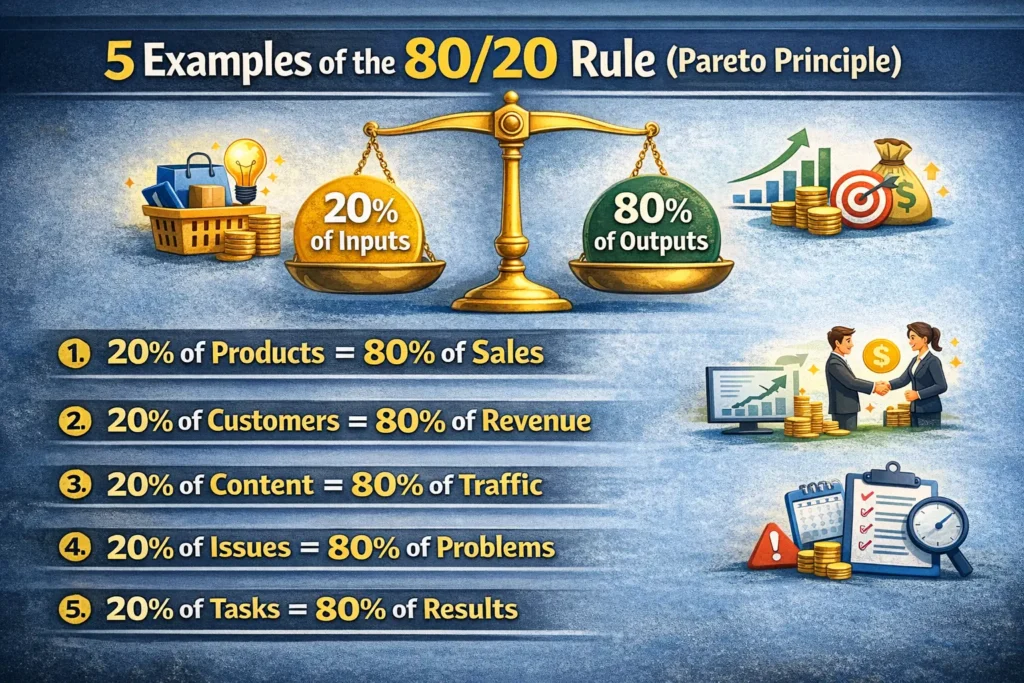
What are 5 examples of the 80/20 rule?
Here are practical *80/20 rule SEO* examples:
1. A few blog posts generate most organic leads
2. A handful of keywords drive the majority of sales
3. Top-performing backlinks provide most ranking power
4. Optimizing existing content yields more results than creating new pages
5. Fixing a small number of technical issues significantly improves performance
Is it true that 20% of people do 80% of the work?
In many organizations, yes. Applied to SEO teams, a small group of high-impact contributors often drives most results. This is why experienced SEO professionals are so valuable.
Does the 80/20 rule really work?
The 80/20 rule isn’t a strict mathematical law, but it’s a powerful strategic lens. In SEO, it helps businesses:
* Prioritize high-impact tasks
* Avoid wasting resources on low-return activities
* Focus on measurable outcomes
Effective SEO services are built around this principle—doing less, but better.
—
Final thoughts: Choosing the right SEO services
SEO services are not just a marketing expense—they’re a long-term investment in your digital presence. When chosen wisely, they can:
* Reduce customer acquisition costs
* Build brand authority
* Deliver compounding returns over time
The key is understanding *SEO cost, **SEO pricing, the **types of SEO, and how principles like the **80/20 rule SEO* guide smarter decisions.
For small businesses, SEO offers an opportunity to compete with larger brands. For growing companies, it provides scalable, sustainable growth. And for any business with an online presence, SEO services are no longer optional—they’re essential.
If you approach SEO strategically, focus on quality over shortcuts, and commit to consistent improvement, SEO can become one of the most valuable assets your business owns.